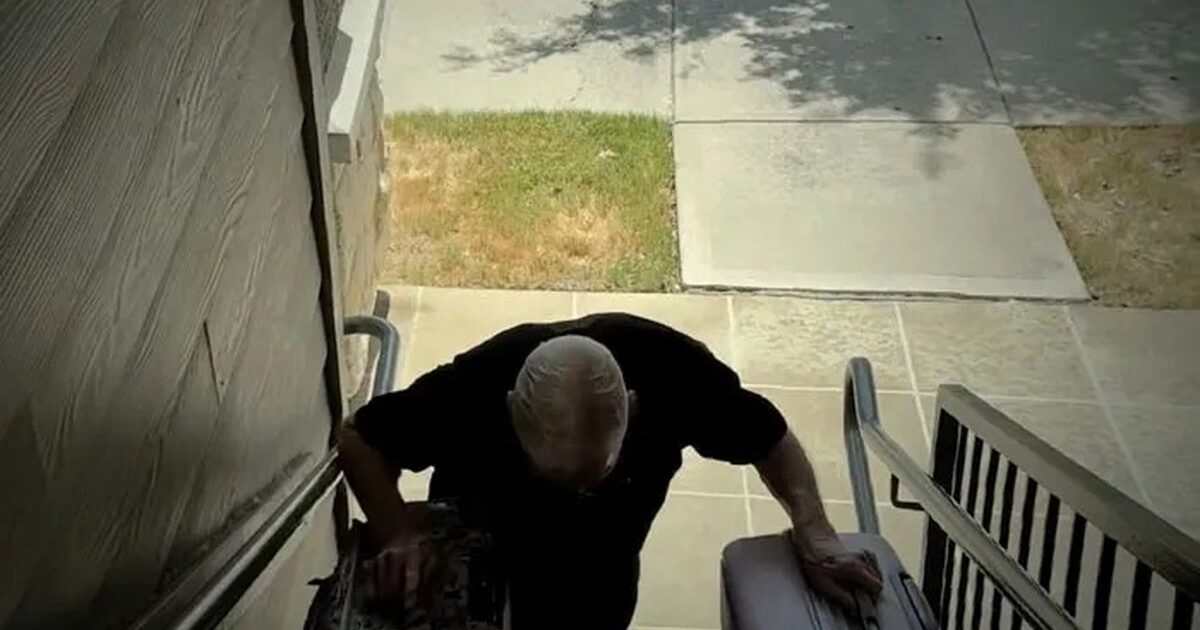
A doorbell camera caught 81-year-old Don Johnson dragging luggage up a flight of stairs, and the clip exploded online as the story of an elderly Texan still hauling deliveries to cover his wife Josephine’s cancer bills. Then GoFundMe got a tip: the “concerned neighbor” behind the fundraiser was the couple’s own daughter — and the platform torched the entire page, refunding every single donor.
The fundraiser had been organized by someone calling herself “Erin Howell,” also appearing as “Erin H.,” presented to donors as a stranger — a concerned neighbor moved by the doorbell footage to step in for a struggling elderly couple. The pitch worked. Donations poured in, shares multiplied, and the campaign became one of the most-shared fundraisers of the week, riding the exact emotional current that makes crowdfunding go nuclear: an 81-year-old man, still working, for his sick wife.
Then came September 25. GoFundMe received a tip about the campaign, investigated, and says it discovered that “Erin” was actually Amy Johnson — Don and Josephine’s daughter. In the platform’s judgment, the fundraiser contained “factual misrepresentations,” and that finding was enough to end it. The page was pulled and every donation was refunded, with GoFundMe confirming the removal and the full donor refunds in its statements.
## The money nobody can agree on
Ask how much the campaign raised and you will get three different answers depending on where you look. Reporting in [The New York Post](https://nypost.com)’s body copy and in [The Cool Down](https://thecooldown.com)’s coverage, which cited NBC, put the total around $281,000 to $290,000. The Post’s own headline, meanwhile, claimed more than $700,000. And an [Oct. 9 blog recap](https://poochinthehouse.wordpress.com) put the figure at $745,000.
None of these can be independently verified now that the page itself is gone — and that is the point. The wildly conflicting totals are part of the story, not a footnote to it. Until someone produces the platform’s own ledger, every figure floating around should be treated as unresolved, not settled.
## Her side: “it would connect better”
Amy Johnson does not deny the identity deception — she admits she invented the stranger persona. Her explanation, in her own words: the story would “connect better” with donors if it arrived as a concerned neighbor’s plea rather than a direct ask from the family itself. She maintains the underlying story is true — that her 81-year-old father was working delivery gigs and her mother is facing cancer bills — and she has taken to TikTok to criticize GoFundMe over the takedown.
She did not stop there. Amy relaunched the fundraiser on GiveSendGo, where it had drawn more than $59,000 by September 28 and, per the Oct. 9 blog recap, climbed past $105,000. It is worth being precise about what is confirmed and what is not: the removal and the refunds are confirmed by GoFundMe’s own statements; the identity switch is admitted by Amy herself; everything else about the family’s situation remains her account, allegation-level, not independently verified.
## Why GoFundMe went nuclear
For the platform, the mechanics are straightforward and brutal. GoFundMe’s terms prohibit fundraising built on misrepresentation — and on a crowdfunding page, who you are and why you are raising money are the two load-bearing facts. When a campaign is removed for a terms violation, donors do not get a partial credit or a voucher for next time. The platform reverses the contributions back to the original payment methods. That is what happened here: a total reset, every donor made whole, and none of the money reaching the family.
The legal logic is cold but clear. If organizers can invent their identities, no donor can price the risk of any campaign on the site. A platform that lets one sympathetic misrepresentation stand invites a thousand less sympathetic ones. So the enforcement is binary — misrepresent, get removed, everyone gets refunded — and it does not matter how moving the underlying story might be.
## The trust problem underneath
Crowdfunding runs on a single currency: trust. The “stranger moved to help” frame is one of the most powerful conversion levers in online fundraising. Donors give faster and more freely when they believe they are joining a spontaneous act of community kindness rather than answering a family’s direct appeal. Amy’s admitted calculation — that the story would “connect better” as a neighbor’s plea — shows she understood exactly that mechanism. And GoFundMe’s response shows the platform understands it too.
That is the uncomfortable core of this story. The deception was not about the need; by Amy’s own account, her father really is 81 and her mother really is sick. The deception was about the distance between the asker and the need — and in crowdfunding, that distance is the product. A neighbor’s plea and a daughter’s plea are two different campaigns with two different conversion rates, and donors were sold one while funding the other.
The saga is not over, either. Though the peak virality ran from September 28 through October 3, the story is still circulating as of October 9, driven by Amy’s TikTok pushback against GoFundMe and the GiveSendGo continuation climbing past six figures. The exact original fundraiser page and TikTok posts could not be independently isolated — itself a reminder of how fast viral fundraising moves, and how little survives once a platform pulls the page.
What remains genuinely unresolved: the true total raised, whether GiveSendGo donors know the full backstory, and whether sympathy for an 81-year-old man hauling luggage can survive the revelation that the plea came from inside the family. GoFundMe has spoken with its refund button. The donors have their money back. The debate about honesty on crowdfunding platforms is just getting started.