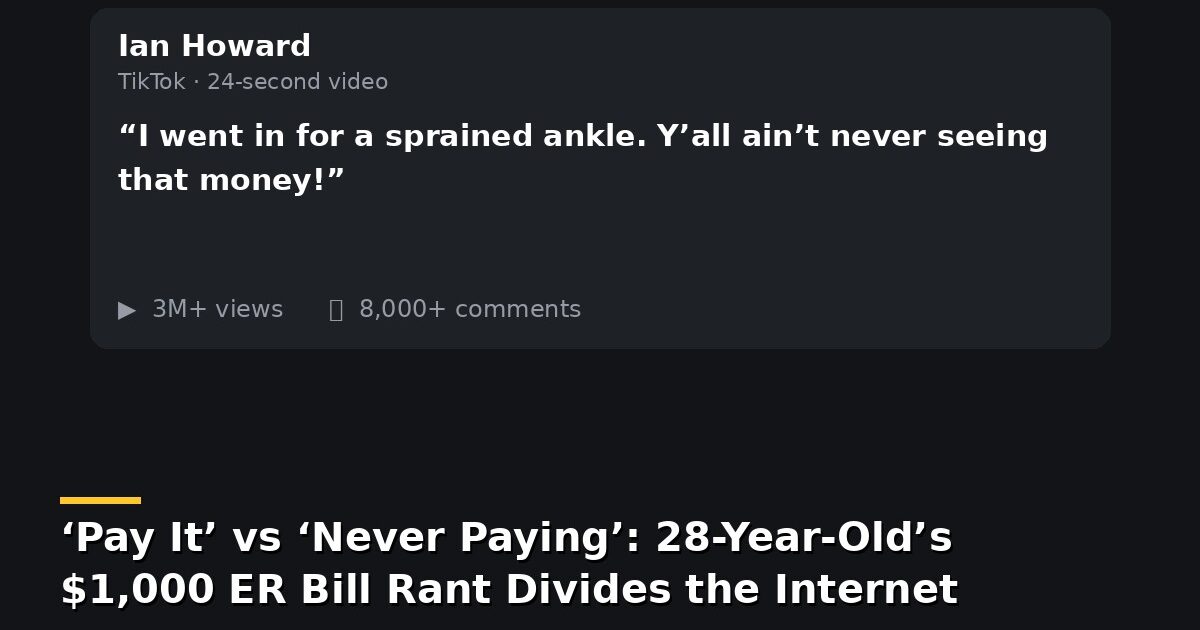
Twenty-four seconds. That’s all it took. A 28-year-old man looked into his phone camera, ranted about a $1,000 emergency-room bill for a sprained ankle, and declared the hospital would never see a dime — and three million people watched. Ian Howard’s TikTok has become the battle cry of a growing movement: Americans who are simply refusing to pay their medical bills.
“I went in for a sprained ankle,” Howard yells in the clip, describing a brief ER visit after a fall. Then the punchline that launched a thousand stitches: “Y’all ain’t never seeing that money!” The 24-second video has racked up more than three million views and over 8,000 comments, many sharing their own stories of hefty bills gone unpaid — and it’s now at the center of a Wall Street Journal report on the influencers telling Americans to stop paying medical bills.
Why $1,000 broke the internet’s patience
Howard told the Journal he posted the video because most people can relate to hospitals “upcharging an insane amount.” He’s reading the room correctly. The rancor over American healthcare bills is exploding right now: millions of Americans are dropping Affordable Care Act plans as subsidies end, swelling the ranks of the uninsured. Even insured patients are increasingly stuck with high deductibles — and coinsurance rules that keep billing them after they’ve already paid thousands out of pocket.
The $1,000 figure is the sweet spot of outrage: large enough to hurt, small enough that millions have lived it. It’s not a $200,000 surgery bill that feels abstract — it’s the price of walking into an ER, being told your ankle is sprained, and walking out. Everyone who’s ever paid a facility fee for a waiting room chair sees themselves in it.
Hospitals are feeling it from the other side. Patient debt and charity-care costs rose 16% in the first half of the year compared to last year, according to Vizient’s Kaufman Hall unit. Unpaid bills are a genuine crisis for providers — which is exactly why the “just don’t pay” movement terrifies them.
The movement behind the rant
Howard isn’t alone — he’s just the loudest. Social media is full of creators advising followers not to pay medical bills, or sharing tactics to slash them: demand itemized bills, challenge every line, apply for financial assistance, negotiate cash prices. Some of it is solid consumer advice. Some of it — the blanket “never pay” posture — is riskier than the rants admit.
Here’s the part the 24-second videos skip: unpaid medical bills don’t vanish. They go to collections. Collections can damage your credit for years, affecting apartment applications, car loans, and even job background checks. Hospitals can and do sue over unpaid balances. And while nonprofit hospitals are required to offer financial assistance programs, you generally have to apply — ignoring the bill isn’t the same as qualifying for help.
That said, the industry’s own billing practices fuel the revolt. “Surprise” facility fees, charges for services never rendered, and bills that arrive months later with no explanation have destroyed trust. When patients feel the game is rigged, “Y’all ain’t never seeing that money” starts sounding less like a tantrum and more like a negotiating position.
What actually works (besides the rant)
If a $1,000 ER bill lands in your mailbox, the viral advice and the boring advice overlap more than you’d think. Request an itemized bill — studies repeatedly find errors in a large share of medical bills. Ask about financial assistance; nonprofit hospitals must have charity-care policies, and many patients who assume they won’t qualify actually do. Negotiate: hospitals routinely accept far less than the billed amount, especially for prompt cash payment. And check whether your state’s consumer protections or your insurer’s appeals process give you leverage.
What you shouldn’t do is confuse “the system is broken” with “bills have no consequences.” They do — just ask anyone who’s been denied an apartment over a collections account.
Howard’s video works because it converts a spreadsheet grievance into pure emotion: 24 seconds, one sprained ankle, one thousand dollars, zero patience left. Whether the “don’t pay” movement actually dents hospital revenues or just dents its followers’ credit scores is the open question. But the fury is real, the views are real, and the $1,000 bill — for millions of Americans — is the most relatable number in healthcare.