The season was on the line, the stadium was shaking, and Anthony Volpe had just saved it — until one fan’s hands ruined everything. With two outs in the bottom of the sixth of ALDS Game 3, Volpe’s drive to deep left field was initially called a two-run homer that tied the game 4-4, but a lengthy replay review turned it into an RBI double after spectator interference, and the Yankees never scored again in a season-ending loss.
The Tampa Bay Rays arrived at Yankee Stadium on October 7, 2026, holding a 2-0 series lead and needing one win to finish the sweep. The Yankees’ season had already been hanging by a thread, and for a few electric seconds in the bottom of the sixth, it looked like Volpe had tied it back together.
Volpe launched one deep to left field with two outs, and Rays left fielder Victor Mesa Jr. broke back at full sprint. Mesa Jr. timed his leap at the wall — and so did a fan in the front row. The spectator reached over the left-field wall and caught the ball just as Mesa Jr. extended for it, the play erupting in chaos before the ball ever came down.
The umpires initially signaled a two-run home run. Volpe rounded the bases and was greeted by a line of high-fives in the dugout while Yankee Stadium roared. It would have been a 4-4 tie and a brand-new game.
Then the headsets went on. The review was lengthy, and the verdict was brutal: spectator interference.
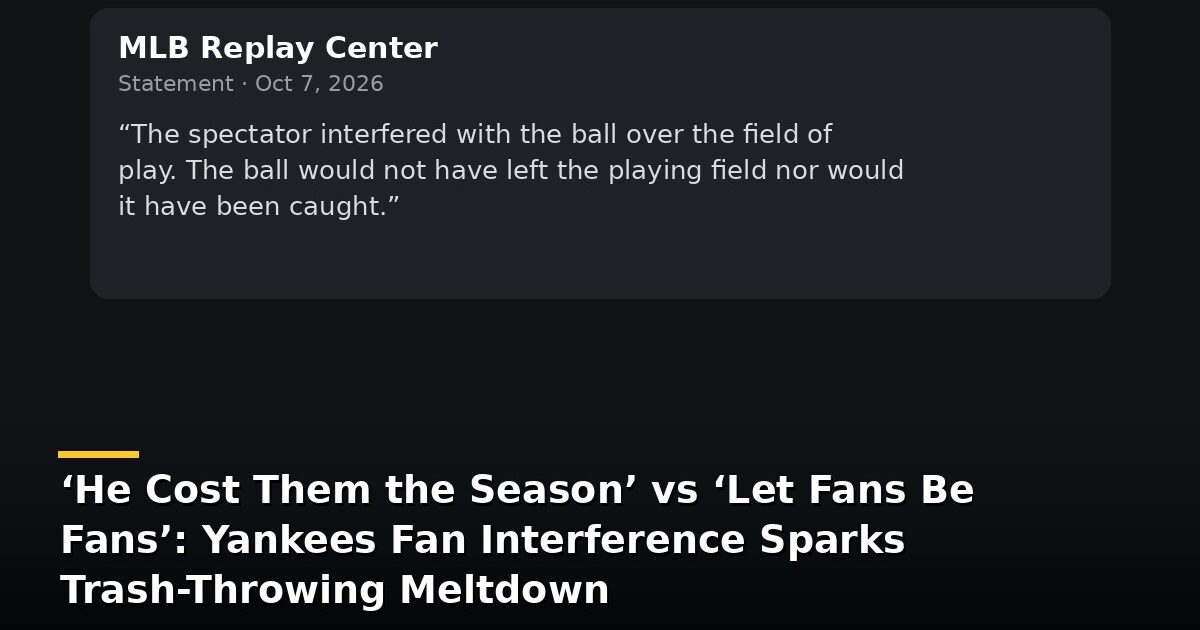
The MLB Replay Center’s statement left no room for argument: “the spectator interfered with the ball over the field of play. The ball would not have left the playing field nor would it have been caught.” Volpe was credited with an RBI double instead — George Lombard Jr. scored from first, trimming the Rays’ lead to 4-3 instead of tying it (NBC Sports).
And that is when the night truly turned ugly.
Furious fans in the left-field seats responded by throwing trash and debris onto the field, sending another wave of delay through a game that had already been stopped cold by the review. Security and grounds crew had to clear the warning track behind Mesa Jr. before play could resume. Spencer Jones then stepped in with Volpe sitting on second and the tying run removed from the scoreboard — and struck out to end the inning.
The Yankees never scored again.
It was an especially cruel twist of fate for Volpe, who watched the replay himself and knew what the slow-motion angles were going to show. His teammate Aaron Judge had loved the contact off the bat. “He almost had a big home run. Off the bat, I liked the chances,” Judge said.
Mesa Jr., the man who had nearly caught it, was certain of what he saw from underneath the play. “It was interference,” he said in Spanish. “I believe I might have even been able to get to that ball.”
The irony of the evening ran deeper than the box score. Mesa Jr. had been the difference-maker at the plate too, crushing a tiebreaking two-run homer off Max Fried in the top of the sixth to give Tampa Bay the 4-2 lead Volpe had nearly erased. One outfielder’s homer put the Rays ahead; another fan’s hands kept them there.
The interfering fan didn’t get to enjoy the moment. He was escorted out of Yankee Stadium by security and police, walked down the outfield aisle as the game resumed without him — the latest name added to a very short, very infamous list.
Because baseball fans have seen this before. Almost exactly thirty years earlier, 12-year-old Jeffrey Maier reached over the wall at the old Yankee Stadium and turned a Derek Jeter fly ball into a home run against Baltimore in the 1996 ALCS — a moment that aided the Yankees rather than hurt them. Wednesday night was Maier’s story in reverse: the same kind of reach, the same October stage, the opposite result.
The sweep is now complete. Tampa Bay moves on, and the Yankees are left with a winter of what-ifs — and one what-if in particular that will be debated all winter long.
On one side: a season that may have died at the hands of one fan’s reach. Ban him from Yankee Stadium for life? Some fans are already saying he deserves worse. On the other: let’s be honest — who among us wouldn’t reach for a postseason ball dropping into the first row of the outfield seats? The instinct to catch a baseball is older than the rulebook itself, and the league’s own replay center admitted the ball wasn’t leaving the yard anyway.
So which is it? A fan who cost his team the season — or just a fan doing what every fan in that seat would have done?